Planning Delivery Routes for a Local Food Co-operative
A practical planning sequence for co-operative deliveries: zones and days first, then time windows and cut-offs, then stop order and how the van is loaded.
Planning delivery routes for a local food co-operative starts long before anyone opens a map. Fix your delivery zones and days first, set realistic customer time windows, close orders early enough to pack by route, then sequence stops and load the van in reverse stop order. The route itself is the last step, and the easiest one to get right once the others are in place.
That ordering matters because a co-operative's route is shaped by things a parcel courier never deals with: many producers, perishable stock, a small fleet that is often one or two vans, and customers who expect the same driver on the same day. Below is the planning sequence we use when running deliveries for a multi-producer short food supply chain.
Why planning delivery routes for a local food co-operative is different
A co-operative route has to collect from many producers, keep chilled and ambient goods apart, hit narrow customer windows and finish inside one working day, usually with one or two vans. Courier software assumes a single depot and parcels that don't spoil, so its defaults rarely fit.
The problem has a name in operations research: the vehicle routing problem with time windows, where every stop can only be served during a set period and the goal is to minimise total travel time across the fleet. A co-operative adds two layers on top. The first is pickups: produce has to reach a packing point, or the van has to collect it, before it can go out. The second is temperature. In the UK, for example, the Food Standards Agency says cold food must be kept at 8°C or below, and most other markets have comparable rules, so a route that leaves dairy or meat in the van for hours is not just slow, it is a food safety problem.
The other difference is scale. Small and mid-sized producers often lack shared infrastructure. A Virginia Tech study for producers found that few had access to aggregation facilities, refrigerated storage or processing spaces, and suggested coordinated pickups and shared trucking routes as a fix. A co-operative is exactly that shared system, which is why its routing deserves more thought than a courier's.
Step one: fix delivery zones and days before you route
Divide your area into a small number of fixed zones and give each zone its own delivery day. Customers in a zone all get delivered on the same day, which turns a scattered week of trips into a few dense, repeatable routes.
This is the single biggest decision. Without zones, every order is a one-off trip and no amount of route optimisation can save it. With zones, Tuesday is the city centre and the eastern villages, Friday is the western suburbs, and the van does a tight loop each time.
When drawing zones, follow roads, not postcodes. A river with one bridge or a ring road with few exits can split a postcode in two in driving terms. Look at where your existing customers cluster, draw zones around those clusters, and only then decide which day each zone gets. Put the zone with the most chilled orders on the day your coldest storage is free.
Keep a minimum order or delivery fee for the outer edge of each zone. A single box twenty minutes beyond the last other stop can cost more in driver time than it earns.
Step two: set time windows and an order cut-off you can keep
Offer customers a few wide time windows rather than exact slots, and close orders early enough to collect, pack and sort by route before the van leaves. A two-hour window and a cut-off at least a day ahead suits most co-operatives.
Narrow windows feel like good service but make routing rigid. Every tight slot pins a stop to a time, and the van ends up zig-zagging across the zone to meet them. Two or three windows per delivery day, such as morning, midday and late afternoon, give the route enough freedom to stay efficient while still telling customers when to be home.
The cut-off depends on your producers, not your customers. If growers harvest to order, they need to know the totals before they pick. That chain works backwards: the route leaves at 9:00, so boxes must be packed by 8:30, so produce must arrive by the evening before, so producers need final quantities a day or two earlier, so orders close then. The way producers declare next week's availability feeds straight into this timetable.
Restaurants and shops often want earlier windows than households. Put trade customers first on the route where you can, since they usually receive goods before opening.
Step three: sequence the stops and load the van in reverse
Order the stops to minimise driving inside the time windows, then load the van so the last stop's crates go in first. The driver should never have to dig past later deliveries to reach the next one.
For a handful of stops, a person who knows the area can sequence a route well by eye. Past roughly a dozen stops with time windows, it gets hard to do reliably, and this is where routing software earns its place. It calculates travel times between every pair of stops and finds an order that respects the windows, which is the vehicle routing problem described above.
Pickups make sequencing harder. If the van collects from producers on the same run, schedule pickups before the deliveries that need that produce, and leave chilled pickups as late as possible so they spend the least time in transit. Many co-operatives avoid this by having producers drop off at a packing point the evening before, which turns the delivery day into a pure delivery run.
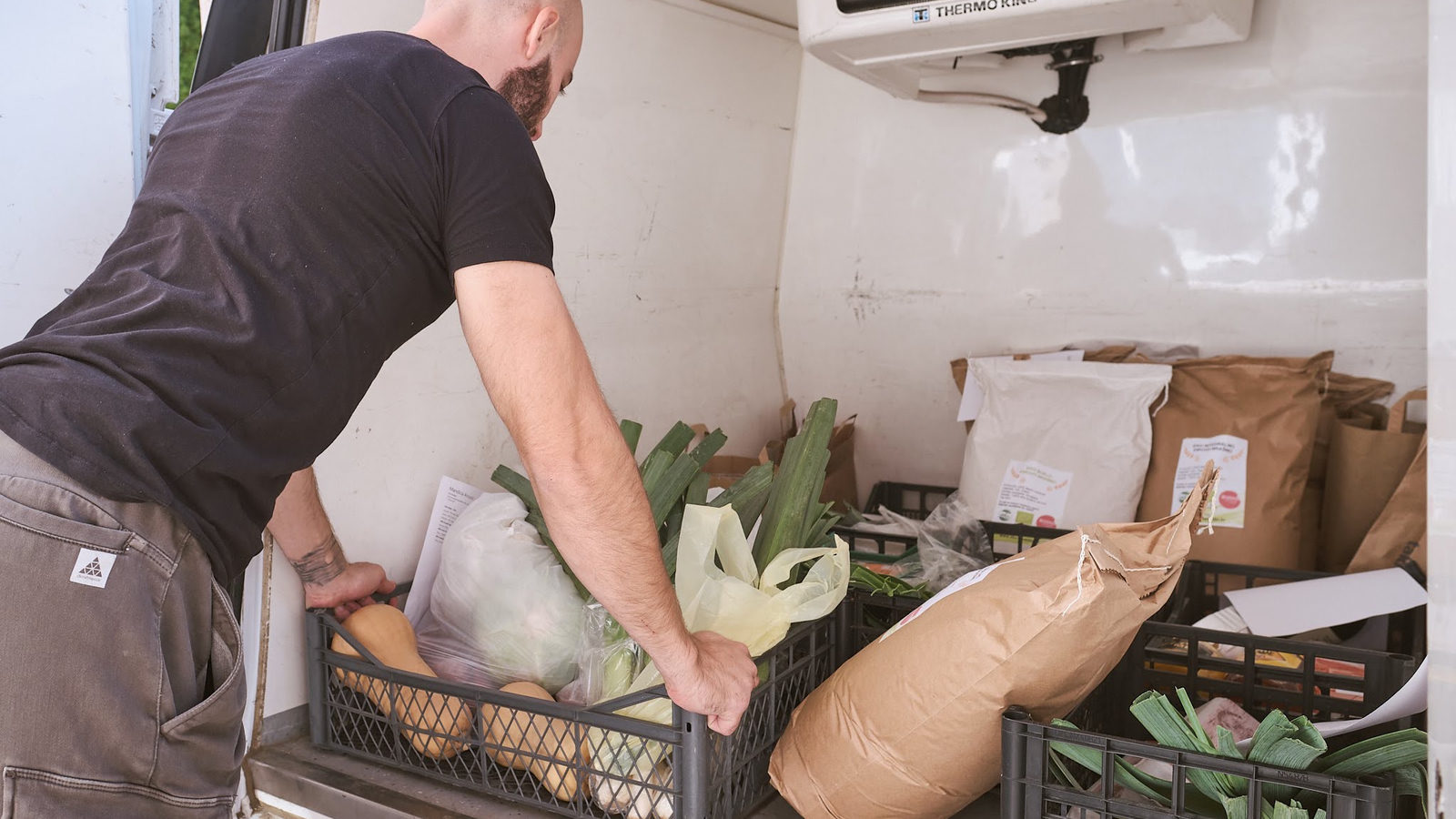
Loading in reverse stop order sounds obvious, but it fails quietly when packing is done by producer instead of by customer. Pack each customer's order as a single unit, label it with its stop number, and stack the van from the highest number to the lowest. Keep a separate cool box or chilled section, also in stop order, so the driver opens it only briefly at each stop. What happens in the final metres of the handover is covered in our piece on the last 200 metres.
Step four: review each route and adjust zones over time
After every delivery day, compare the planned route with what actually happened: start and finish times, late stops, failed deliveries and returned produce. Small, regular adjustments to zones, windows and cut-offs do more than any single optimisation.
Three signals are worth watching. If one zone regularly runs late, it has too many stops for one van or one day and should be split. If a time window is always full while another is empty, rebalance them. If the same customers often aren't home, move them to a different window or offer a safe drop point.
Route records also have a second use. The distance driven and the stops served are the raw material for a food miles report that you can back up for funders and customers, and they show whether a new zone actually pays for itself.
Finally, give drivers a way to report back. A note that a gate code changed or a customer prefers the back door saves the next driver ten minutes. Over a season, those notes are worth more than any routing algorithm.
Key takeaways
- Fix delivery zones and days first; routing can only optimise what zoning makes possible.
- Offer a few wide time windows and set the order cut-off by working backwards from when the van leaves and when producers harvest.
- Sequence stops to respect the windows, pack by customer, and load the van in reverse stop order with chilled goods kept separate.
- Review every route afterwards and adjust zones, windows and cut-offs in small steps.
Plodie's Delivery app is built around this sequence, from zones and windows to stop order and driver notes, because we run the same routes for our own co-operative every week.
FAQ
How do small producers coordinate a weekly delivery day?
Most agree a fixed order cut-off and a fixed drop-off time at a shared packing point. Each producer delivers their share the evening before, the co-operative packs by customer, and one van runs the route the next morning. Fixed days per zone keep the pattern predictable for everyone.
Do I need routing software for a small food co-operative?
Not at first. With fewer than a dozen stops in one zone, a driver who knows the area can sequence the route by hand. Once you have several zones, time windows and pickups on the same run, software that calculates travel times and respects windows saves real time and mistakes.
How do you keep chilled produce cold on a delivery route?
Keep chilled goods in a refrigerated van section or insulated boxes with cold packs, loaded in stop order so they are opened as briefly as possible. Schedule chilled pickups late and chilled deliveries early in the route, and follow your country's temperature rules for food in transit.
How can better order planning reduce food waste?
Closing orders before producers harvest means they pick what is actually sold rather than guessing. Clear time windows and accurate addresses cut failed deliveries, which are a common source of wasted perishables. Route reviews show where returns happen so you can fix the cause.